March 23rd's lecture covered Art Deco Moderne. The style expressed the desires of the modern era and geometric designs. Streamlining and zigzag designs were featured in this style. During this time people had a lot of faith in the machine era; the 1920's and 1930's. Probably the greatest illustrator of the 20th century was A.M. Cassandre who revitalized advertising using Surrealist Metaphor. His designs were bold and dramatized 2-D and used iconic symbols. He mastered scale shifts effectively.
After the World Wars advertising posters for other countries featured foreigns styles created by a different country. For example, a United States created poster featured European styles to promote that particular country. Ludwig Hohlwien revolutionized Victory Metaphors by promoting the Olympic Games during Nazi Germany. His work corresponded with Hitlers concept of virtuous propaganda. Around the same time Montgomery Flag branded Uncle Sam as an American Symbol. Another influence on Art Deco Moderne was Herbert Matter who created pictorial symbols by using silhouetted photographs, used uncommon angles, Incorporated micro and macro styles and used overprinting and transparencies.
I never realized how influenced people were by art during the World Wars until I saw it in class. I always wondered how people believed Hitler and were influenced into believing in what their country stood for until I viewed the posters that revolutionized the wars. They seemed sincere and patriotic. Obviously what one believes is majorly determined by what one has always been brought up to believe give or take a few very persuasive characters.
Monday, March 23, 2009

Monday, March 16, 2009
The Bauhaus & New Typography
The Bauhaus supported a type of modernism style of design. Their purpose was "to solve design problems created by industrialization." The Bauhaus wanted the modern look by using mass production. This modern style was calculated by the use of type and image. Photoplastics were invented by a Bauhaus Master, Moholy Nagy. These photoplastics created a surrealism style of design. Using the camera as a tool, Nagy created a new visual language for photography. He also applied the componets of the Bauhaus design legacy. During this time many designers escaped to America to avoid the Nazi persecution.
Then the style of design changed Jan Tschichold was the best spokesman to describe the new style as New Typography. This style introduced more white space, elementary typefaces without elaberation, symmetrical organization, and dynamic forces for everyday design. After a while Tschichold realizes the limitations of the modern style of New Typography and declairs that the old traditions provide more freedom to thought and expression. However several artists still made an impact to this movement such as Paul Shoetema, Hendrick Werkman, and Piet Zwart.
I've never been one to favor the modern design. I find it hard to interpret. Maybe that's because of my upbringing, I've always been used to the playful colorful, traditional decorative designs. Even though I found them not my style I still bought my friend square dinner plates for her wedding gift. She explained that they wanted something different. In a world were modern design is becoming more favored being 'different' is not so hard. The only challenge is designing something modern differently.
Then the style of design changed Jan Tschichold was the best spokesman to describe the new style as New Typography. This style introduced more white space, elementary typefaces without elaberation, symmetrical organization, and dynamic forces for everyday design. After a while Tschichold realizes the limitations of the modern style of New Typography and declairs that the old traditions provide more freedom to thought and expression. However several artists still made an impact to this movement such as Paul Shoetema, Hendrick Werkman, and Piet Zwart.
I've never been one to favor the modern design. I find it hard to interpret. Maybe that's because of my upbringing, I've always been used to the playful colorful, traditional decorative designs. Even though I found them not my style I still bought my friend square dinner plates for her wedding gift. She explained that they wanted something different. In a world were modern design is becoming more favored being 'different' is not so hard. The only challenge is designing something modern differently.
Monday, March 2, 2009
Russian Graphic Design
Russian graphic art seemed to take the country by storm. Their influence not only persuaded other graphic designers but the Russian society as well. One movement that came about was the Suprematism, designers who used only pure form and color. It was an abstract visual language that was understood. The Constuctiveness Movement only lasted 5 years but the impact caused designers to oppose the old orders and rules of graphic design. For the first time photos have a power illustrations couldn't ever convey and photographic persuassion was at its all time high both socially and politically. Tectonics, texture and construction were the primary elements of design at the time. Alexander Rodchenko, a master of tectonics, contributed majorly to the design world. He created the unisex "communist suit" and used mainly photographs when designing and modern packaging. Photographs were primarily used for personal expression. Photomontaging had several techniques that were followed: simutaneous action, superimposing images, extreme close-ups and perspective, and rhythmic repetition. Photomontaging was not only theactical but cienematic. However, no one could compare to El Lissitzky who was a visionary at heart. He developed the painting style called Prouns, a synthesis of architectural concepts. One of the major most commonlly seen aspects of Russian graphic design was the 'utopian eye'; where common men and women shared a vision as equals.
Friday, February 27, 2009
The Reality Is In The Eye Of The Beholder
• No ugliness in photography
• "I find that ugly thing...beautiful."
• People want a photo of themselves at their best
• Photographs are praised by their candor and honesty
• After a photographer experimented with photo alteration the idea that the camera could lie made getting photographed much more popular
• Photographs make a claim true
• Paintings can falsify history of art; photographs can falsify reality
• "while we give it credit only for depicting the nearest surface, it actually brings out the secret character with a truth that no painter would ever venture upon, even could he detect it."
• Photographs do not simply render reality - realistically. It's reality which is scrutinized, and evaluated, for its fidelity to photographs.
• "You can not claim to have really seen something until you have photographed it."
• Photographs have become the norm for the way things appear to us, changing the very idea of reality and of realism.
I have to say that I only halfheartedly agree with Susan Sontag, author of On Photography, who seems to be more of a purist. Several people could be looking at one photograph and each might see a different 'reality'. Reality seems like such a concrete word, but really it will depend on everyone's own experience and point in life. Reality for someone young might be school or a broken family or even a life changing (and I use this term loosely) 'mistake'. Reality for an individual might be children or working several jobs to pay the bills or health problems. Peoples reality is colored by their experience at that particular time. Yes, a photograph used to be simply that, just a photograph; something to capture the exact moment in time. Today, photographs show the viewer what either he or she wants to see but also what the photographer wants you to see as well as the viewers interpretation.

In this painted portrait of a girl holding two cats, reality is really only implied. What exactly do you see when you look at this image? Is what we see now true of what was seen through the artist's eyes? We think we know the facts by what we see, but we can't tell her expression. The artist can give the girl the expression they want the viewer to see. Even though this portrait does show a moment in time it still seems more like art than reality.
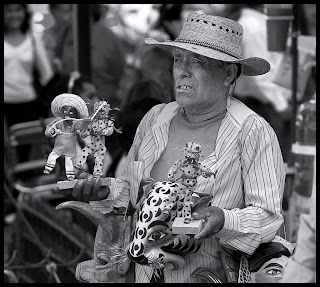
In the photograph of the salesman to the right, we can actually see an expression. Even though the expression might seem different to everyone it gives an incite to his character, mood and personality. His wrinkles show a true honesty instead of being idealistic. Photography causes the viewer to question it, wanting to know more; unlike a painting where the artist shows you what to see.
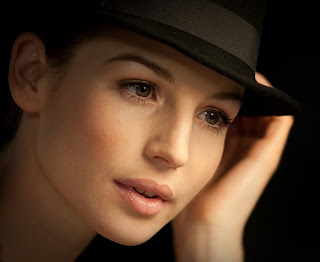
People who don't like their photos taken don't usually hide from the camera because they hate the camera. They usually fear not looking their best. To the left, this photographic portrait seems staged. She's very photogenic, but does the subject look like that in real life? When a German photographer experimented with altering photos, photographs became much more popular, because then everyone could look their best. We are so used to seeing photographs, very few question it's honest reality. Now, frequently the time, they are altered in some way to enhance the overall quality. Being physically idealistic has been taken to a whole new level.
Reality is just a harsh way of saying 'it is what it is, and always will be.' Art is a lighter way of showing the artist's reality. Photographs are honest expressions of reality for only a split second in time. Photographic Art...I'll let you decide.
• "I find that ugly thing...beautiful."
• People want a photo of themselves at their best
• Photographs are praised by their candor and honesty
• After a photographer experimented with photo alteration the idea that the camera could lie made getting photographed much more popular
• Photographs make a claim true
• Paintings can falsify history of art; photographs can falsify reality
• "while we give it credit only for depicting the nearest surface, it actually brings out the secret character with a truth that no painter would ever venture upon, even could he detect it."
• Photographs do not simply render reality - realistically. It's reality which is scrutinized, and evaluated, for its fidelity to photographs.
• "You can not claim to have really seen something until you have photographed it."
• Photographs have become the norm for the way things appear to us, changing the very idea of reality and of realism.
I have to say that I only halfheartedly agree with Susan Sontag, author of On Photography, who seems to be more of a purist. Several people could be looking at one photograph and each might see a different 'reality'. Reality seems like such a concrete word, but really it will depend on everyone's own experience and point in life. Reality for someone young might be school or a broken family or even a life changing (and I use this term loosely) 'mistake'. Reality for an individual might be children or working several jobs to pay the bills or health problems. Peoples reality is colored by their experience at that particular time. Yes, a photograph used to be simply that, just a photograph; something to capture the exact moment in time. Today, photographs show the viewer what either he or she wants to see but also what the photographer wants you to see as well as the viewers interpretation.

In this painted portrait of a girl holding two cats, reality is really only implied. What exactly do you see when you look at this image? Is what we see now true of what was seen through the artist's eyes? We think we know the facts by what we see, but we can't tell her expression. The artist can give the girl the expression they want the viewer to see. Even though this portrait does show a moment in time it still seems more like art than reality.

In the photograph of the salesman to the right, we can actually see an expression. Even though the expression might seem different to everyone it gives an incite to his character, mood and personality. His wrinkles show a true honesty instead of being idealistic. Photography causes the viewer to question it, wanting to know more; unlike a painting where the artist shows you what to see.

People who don't like their photos taken don't usually hide from the camera because they hate the camera. They usually fear not looking their best. To the left, this photographic portrait seems staged. She's very photogenic, but does the subject look like that in real life? When a German photographer experimented with altering photos, photographs became much more popular, because then everyone could look their best. We are so used to seeing photographs, very few question it's honest reality. Now, frequently the time, they are altered in some way to enhance the overall quality. Being physically idealistic has been taken to a whole new level.
Reality is just a harsh way of saying 'it is what it is, and always will be.' Art is a lighter way of showing the artist's reality. Photographs are honest expressions of reality for only a split second in time. Photographic Art...I'll let you decide.
Monday, February 23, 2009
Just Another "Throw Of The Dice"
The lecture given on February 23rd covered the early 20th century of graphic design. Synthetic Cubism was simplified forms of graphic essence, such as the work of the famous Picasso. Seven-Second-Medium was a term used to catch the eye of traveling pedestrians. Around this time when the worlds broke out artist began to use propaganda. The most famous and well known of these posters and art is the Uncle Sam pointing "I Want You." On the the greatest movements was the Dada Movement. Consisting mainly of poets and writers the Dada's purpose was the eliminate the sensible with absurd non-sense. The Dada's declared no style, as they were against it. They also participated in destructive activities to draw attention to their purpose or cause. It is also said that they invented the photomontage, which is found images that are rearranged.
I wonder how Man Ray created his 'rayograms' since nowadays its expensive to get an x-ray. I found this part of the lecture the most interesting. It causes me to wonder what I can do with x-ray film since my father works in radiology. Not that I could get him to sneak me in to work on the million dollar or so machines. I don't know if they use the turn anymore but I still think the Seven-Second-Medium applys to us nowadays. Now there is a relatively new system of advertising as companies have put them on wheels. You may spot a truck or two between Sarasota and Tampa with rotating ads on them. This kind of advertising creates a whole new way of advertising as companies must get their profession and phone number across to the viewer, minimum. I always tell my mom about a new fashion trend that take place and she just tell me, "No, it just a comeback." Well, the say goes for art as well. It usually always started somewhere.
I wonder how Man Ray created his 'rayograms' since nowadays its expensive to get an x-ray. I found this part of the lecture the most interesting. It causes me to wonder what I can do with x-ray film since my father works in radiology. Not that I could get him to sneak me in to work on the million dollar or so machines. I don't know if they use the turn anymore but I still think the Seven-Second-Medium applys to us nowadays. Now there is a relatively new system of advertising as companies have put them on wheels. You may spot a truck or two between Sarasota and Tampa with rotating ads on them. This kind of advertising creates a whole new way of advertising as companies must get their profession and phone number across to the viewer, minimum. I always tell my mom about a new fashion trend that take place and she just tell me, "No, it just a comeback." Well, the say goes for art as well. It usually always started somewhere.
Monday, February 9, 2009
"To Each Age It's Art, To Art It's Freedom"
February 9th lecture focused on the Art Nouveau period. Even though the art influence only had a 20 year life span, artist contributed quite a bit in to this period. New forms were invented and ornamentation became structural. Visually the art is linear with textural and color areas. The concept made the art appear apart of everyday life. In the beginning the art seemed rather unusual having a fantasy like quality and was often used as poetic imagery. Women were often used in the art which created a motif creating an idealized beauty. Artists expanted their abilities by limited the art visually. One style was the 'Coloring Book Style' which consisted of thick, black outlines which totally completed the form.
Later artist decided to challenge the mind of viewers creating flat color and sharp silhouettes, allowing the viewer to mentally complete the imagery or story themselves. Backgrounds were later eliminated so the viewer could focus on the neccesary points. A major movement of this time period was the Jugendstil movement. Jugen meaning youth, and stil meaning movement. This movement took fantasy a step further by using non-traditional forms to stress commodity, culture, and alientation. The Secession movement was a clash between traditional and new ideas. Art Nouveau didn't stop there however. Artist broke away from floral patterns creating mathamatical patterns using geometric shapes.
For such a short time period, Art Nouveau influenced a great deal of artists. I haven't quite decided yet how I feel about the art. I'm mixed between liking it and hating it. I believe I'm more fond of the visually constricted art. The pieces that let the eye and mind complete the image for itself. I believe that is a major leap for design because each viewer has their own interpretation. In another class I have someone can have a different personal interpretation than another based on their experience. I've never been good with geometry but it seems the world continues to try to make sense of the world though patterns. Like the continuous spiral that never seems to end and goes on forever. Artist will always try to touch the world with their new discoveries. Discoveries aren't something that should be kept but shared.
Later artist decided to challenge the mind of viewers creating flat color and sharp silhouettes, allowing the viewer to mentally complete the imagery or story themselves. Backgrounds were later eliminated so the viewer could focus on the neccesary points. A major movement of this time period was the Jugendstil movement. Jugen meaning youth, and stil meaning movement. This movement took fantasy a step further by using non-traditional forms to stress commodity, culture, and alientation. The Secession movement was a clash between traditional and new ideas. Art Nouveau didn't stop there however. Artist broke away from floral patterns creating mathamatical patterns using geometric shapes.
For such a short time period, Art Nouveau influenced a great deal of artists. I haven't quite decided yet how I feel about the art. I'm mixed between liking it and hating it. I believe I'm more fond of the visually constricted art. The pieces that let the eye and mind complete the image for itself. I believe that is a major leap for design because each viewer has their own interpretation. In another class I have someone can have a different personal interpretation than another based on their experience. I've never been good with geometry but it seems the world continues to try to make sense of the world though patterns. Like the continuous spiral that never seems to end and goes on forever. Artist will always try to touch the world with their new discoveries. Discoveries aren't something that should be kept but shared.
Monday, February 2, 2009
"Designers Touch Everything"
Interesting points that caught my attention in class was the birth of Mass Communication. Beginning in the 1700's communication seemed to be more about art form more than news itself. Fat face and style type introduced themes to design, creating an atmospheric mood with just letter forms themselves. The boxy type style of fonts, San Serifs, were introduced by William Calson in England, 1816. Larger scale lettering became overly competitive for visual impact. In the 1800's the first photograph was printed in media using emulations. The Victorian period brought about the dawn of the Art of Persuasion. A major key element in this lecture was chromolithography, which was a technique to massively produce print in color. This brought about product packaging. Something that interested me the most was the creator of seasonal greeting cards, Louis Prang.
It seems that everything in this lecture leaded to the birth of everything that I know well today. Even though I believe that greeting cards have become somewhat unnecessarily abundant, you can find thousands of designs on store shelves today. It amazes me how long something continues to have an impact on society today. I'm sure the Harper Brothers, who created the first people magazine, had information that was actually useful to the people instead of some of the celebrity gossip where the front cover bears two different stories and the magazines sit on the same self. The lecture today still helped me understand a great deal of where the 'original' ideas came from and helped me appreciate the brilliant ideas that brought us to become the designers we are today.
It seems that everything in this lecture leaded to the birth of everything that I know well today. Even though I believe that greeting cards have become somewhat unnecessarily abundant, you can find thousands of designs on store shelves today. It amazes me how long something continues to have an impact on society today. I'm sure the Harper Brothers, who created the first people magazine, had information that was actually useful to the people instead of some of the celebrity gossip where the front cover bears two different stories and the magazines sit on the same self. The lecture today still helped me understand a great deal of where the 'original' ideas came from and helped me appreciate the brilliant ideas that brought us to become the designers we are today.
Subscribe to:
Posts (Atom)